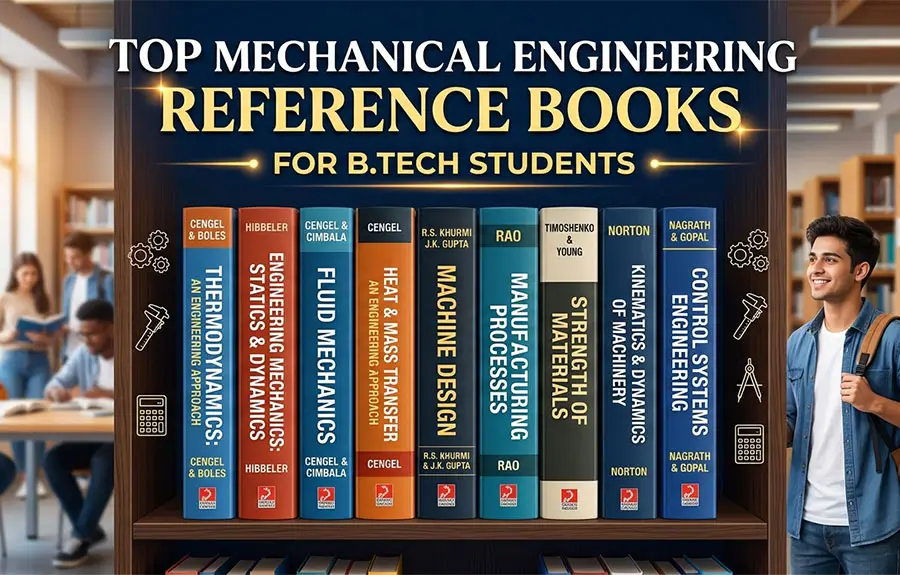
Mechanical engineering is one of the oldest and most respected branches of engineering. It plays a crucial role in industries such as manufacturing, automobile design, aerospace, robotics and energy production. Students pursuing B.Tech in Mechanical Engineering must develop a strong understanding of fundamental engineering concepts to succeed both academically and professionally.
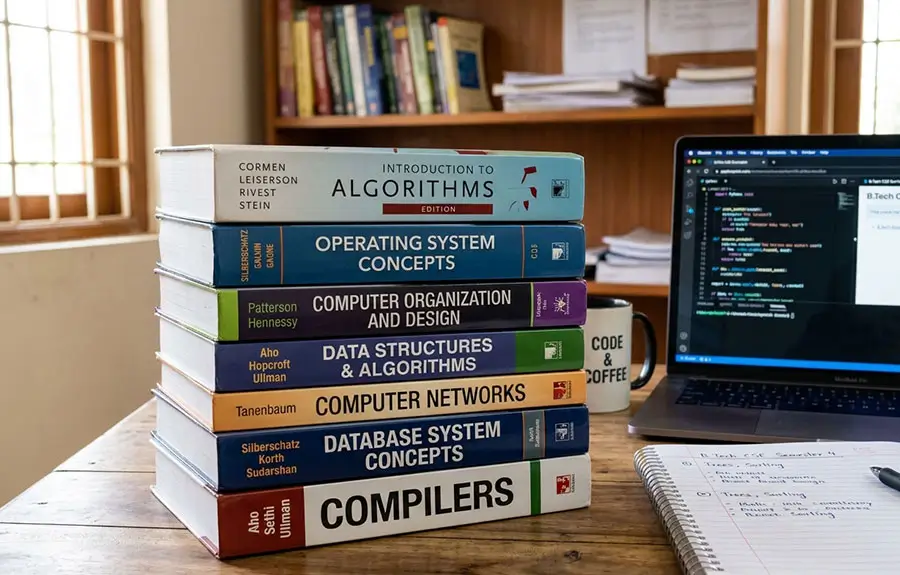
While university textbooks provide essential theoretical knowledge, many students rely on mechanical engineering reference books to gain deeper conceptual clarity and practice additional problems. These books are written by experienced authors and often include detailed explanations, solved examples and real-world engineering applications.
Choosing the right reference books for mechanical engineering students can significantly improve academic performance and help students prepare for technical interviews, competitive exams and higher studies.
Mechanical engineering is a vast field that includes subjects such as engineering mechanics, thermodynamics, fluid mechanics, machine design, and manufacturing processes. Reference books covering these subjects help students understand complex concepts and apply them effectively in practical situations.
Engineering subjects often involve detailed mathematical analysis and practical problem-solving. Reference books help students understand these concepts more clearly by providing step-by-step explanations and additional practice questions.
Many mechanical engineering study books present theoretical concepts along with practical examples from real-world engineering applications. This approach helps students understand how classroom knowledge is applied in industries.
Another advantage of reference books is that they provide extensive problem sets. Solving these problems helps students develop analytical thinking and strengthens their ability to solve engineering challenges.
Reference books are also useful for students preparing for exams such as GATE, engineering services examinations, and technical interviews.
Engineering mechanics is one of the foundational subjects in mechanical engineering. It introduces students to concepts such as forces, motion, equilibrium, and structural analysis.
Books focusing on engineering mechanics for mechanical engineers explain principles such as statics and dynamics in a structured manner. These books help students understand how forces act on bodies and how mechanical systems behave under different conditions.
Mechanics books usually include diagrams, mathematical derivations and problem-solving exercises. Practicing these exercises helps students develop a strong understanding of mechanical principles.
Students who master engineering mechanics often find it easier to understand advanced subjects in mechanical engineering.
Thermodynamics is another core subject in mechanical engineering. It deals with energy transfer, heat, work and the laws governing thermal systems.
Reference books focusing on thermodynamics for engineering students explain concepts such as the laws of thermodynamics, heat engines, refrigeration systems and energy efficiency.
These books often include numerical problems that require careful analysis and calculation. Solving these problems helps students develop strong problem-solving skills.
Thermodynamics knowledge is essential for careers in industries such as power plants, refrigeration, automobile engineering and aerospace technology.
Fluid mechanics studies the behavior of liquids and gases in motion and at rest. It is an important subject for mechanical engineering students because it has applications in areas such as aerodynamics, pipeline systems, and hydraulic machines.
Books focusing on fluid mechanics for mechanical engineering explain concepts such as fluid pressure, flow dynamics, viscosity and energy transfer in fluids.
These books often include graphical illustrations and numerical problems that help students visualize fluid behavior in different conditions.
Understanding fluid mechanics helps students design systems such as pumps, turbines, hydraulic equipment and ventilation systems.
Manufacturing engineering focuses on the processes used to produce mechanical components and machines. Students studying this subject learn about machining, casting, welding, forming and other production techniques.
Books covering manufacturing processes in mechanical engineering explain different methods used in industrial production. These books also describe the properties of materials and how they behave during manufacturing operations.
Many reference books include case studies and diagrams that illustrate how machines and tools are used in manufacturing industries.
Understanding manufacturing processes helps students develop practical engineering skills that are valuable in industrial environments.
Machine design is one of the most important subjects for mechanical engineering students. It involves designing mechanical components such as gears, shafts, bearings and springs that can withstand different loads and operating conditions.
Books focusing on machine design for mechanical engineers explain concepts such as stress analysis, fatigue strength and material selection. These books often include design calculations and engineering drawings that help students understand how machines are constructed.
Learning machine design helps students develop the ability to create efficient mechanical systems and improve existing machine components.
Strength of materials is a subject that deals with the behavior of materials under different types of stress and strain. It helps engineers determine how materials respond to forces and how structures can be designed safely.
Reference books covering strength of materials for mechanical engineering explain concepts such as bending, torsion, shear stress and deformation.
These books often include solved examples and practice problems that help students understand structural behavior in engineering applications.
Strong knowledge of this subject is essential for designing safe and reliable mechanical structures.
Reference books not only help students perform well in university exams but also prepare them for professional careers. Many engineering graduates rely on these books when preparing for competitive exams such as GATE, engineering services examinations and technical interviews.
Books written by experienced professors and industry experts often include practical examples and case studies that demonstrate how engineering principles are applied in real-world situations.
Students who regularly study from reliable mechanical engineering reference books develop stronger conceptual understanding and technical confidence.
This knowledge becomes extremely valuable when working on engineering projects, research work or industrial assignments.
The market offers a wide range of engineering books, but students should choose books written by recognized authors and published by reputable publishers. Good reference books usually explain concepts clearly and include sufficient practice problems.
Students should avoid collecting too many books for the same subject. Instead, focusing on a few reliable books and revising them regularly helps improve conceptual clarity.
A disciplined study approach combined with high-quality mechanical engineering study material helps students build a strong academic foundation and prepare for future engineering challenges.
Mechanical engineering is a dynamic field that continues to evolve with technological advancements. With the right reference books and consistent practice, students can develop the knowledge and skills required to succeed in this exciting discipline.
Reference books provide deeper explanations and additional practice problems beyond textbooks.
Subjects such as thermodynamics, mechanics, machine design and fluid mechanics benefit from reference books.
Yes, many reference books are widely used for GATE exam preparation.
Most engineering books contain solved numerical examples and practice exercises.
Yes, it is a core subject related to energy systems and heat transfer.
Fluid mechanics studies the behavior of liquids and gases in motion and at rest.
It helps engineers design safe and efficient mechanical components.
Yes, they explain industrial production techniques and machine operations.
It is better to focus on a few reliable books rather than too many sources.
Students can purchase engineering books from trusted online bookstores that provide technical study material.

We offer fast delivery.

We offer E-Gift Cards.

Dedicated 24/7 support.

100% secure payment.

 My Order
  0
0