Handwriting is one of the most important foundational skills children develop during early learning years. Before kids begin writing alphabets, numbers or sentences independently, they must learn how to control their hands, form shapes, draw lines and develop confidence in structured movement. Tracing books provide the perfect bridge between early motor exploration and formal handwriting. These books help children strengthen grip, improve control, build pattern understanding and practice consistent strokes that prepare them for clear, neat and confident writing.
Tracing is not merely an exercise; it is a complete developmental process. When children trace lines, shapes, letters and patterns, they engage multiple areas of the brain responsible for coordination, focus, memory and spatial understanding. Tracing teaches children how to move their hands correctly, follow directional paths and recognise letter structures. These experiences shape the foundation for writing speed, accuracy and readability.
For many children, writing can feel overwhelming at first. Tracing reduces this pressure by guiding them through controlled paths. Instead of creating letters from scratch, children follow outlines. This builds confidence and reduces frustration, making writing feel manageable. Tracing books are designed to offer gradual progression — from straight lines to curves, shapes, patterns and eventually letters — ensuring children learn step-by-step in an encouraging way.
Tracing books offer structured practice that prepares children for real handwriting. Writing is not just about forming letters; it requires muscle strength, spatial awareness, proper posture and controlled hand movement. Tracing helps children develop each of these components naturally.
These books support essential early writing abilities:
Tracing also builds familiarity with writing instruments. Whether kids use crayons, pencils or markers, repeated tracing helps them develop a stable, comfortable grip. This reduces fatigue and encourages correct writing posture.
Before children begin writing alphabets, they must learn how to control movement. Tracing bridges this gap perfectly by providing guided learning.
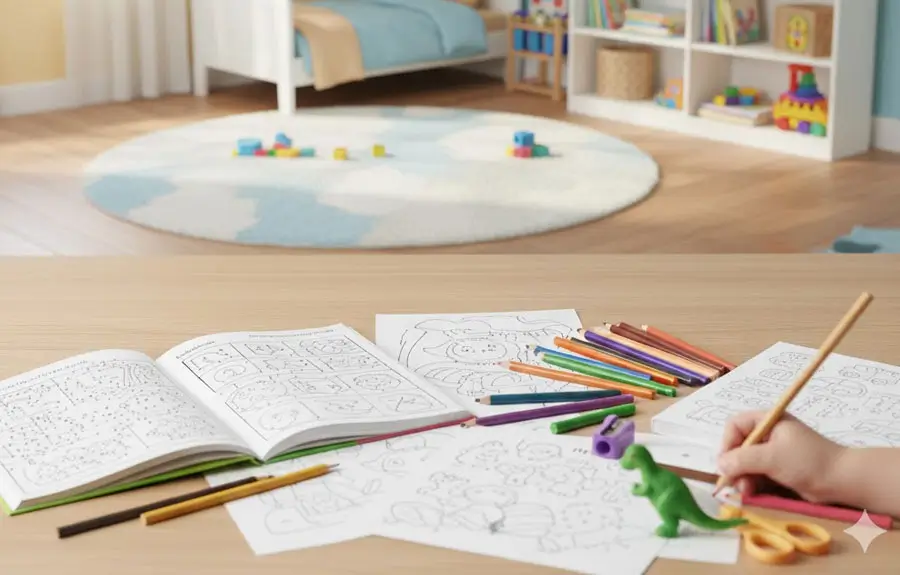
Fine motor skills involve small muscle movements of the hands and fingers. These skills are crucial for writing, buttoning, tying, drawing and completing everyday tasks. Tracing books strengthen fine motor skills through controlled practice.
When kids trace:
they develop precision, stability and grip strength. Each tracing exercise strengthens finger muscles and improves wrist movement. These skills directly support handwriting readiness.
Tracing also enhances finger isolation — the ability to move individual fingers independently. This improves pencil control and helps children produce cleaner strokes.
Fine motor development acquired from tracing creates a solid base for academic tasks that require accuracy and neatness.
Hand–eye coordination refers to how well the eyes guide the hand during movement. Tracing books are one of the best tools for improving this skill because children must visually follow a line while moving their hand in the same direction.
When tracing:
This simultaneous action strengthens neural pathways that support handwriting, drawing, sports and daily activities. Children who practise tracing show better visual tracking, smoother strokes and reduced hesitation when writing letters independently.
Improved hand–eye coordination also helps children space letters correctly, maintain alignment and write neatly on ruled lines.
Tracing activities require children to slow down, pay attention and follow a path carefully. This naturally improves concentration. Kids learn that rushing may cause them to go outside the lines, encouraging mindful movement.
Over time, tracing helps children:
This increased concentration benefits all areas of learning, especially tasks requiring structured attention such as reading, math practice and problem-solving.
Before kids write letters, they must learn basic strokes. Pattern tracing introduces these strokes in a gradual, child-friendly format. Common patterns include:
These patterns teach children essential writing movements without overwhelming them. For example:
Pattern repetition builds muscle memory. When children internalise these strokes, they write alphabets more naturally and confidently.
Once children master patterns, tracing books introduce letters. Letter tracing includes uppercase and lowercase forms. This helps children understand letter shapes, proportions, starting points and stroke directions.
Letter tracing supports:
Children learn that each letter has a specific structure and sequence. Tracing reinforces this sequence repeatedly. This prepares children for independent writing without confusion or reversal of letters.
Letter tracing also improves phonics learning. When children trace a letter while saying its sound, they connect literacy skills through multisensory learning — visual, auditory and motor.
Spatial awareness helps children understand how objects relate to each other in space. In handwriting, this understanding determines:
Tracing books help develop this awareness by teaching children where lines begin and end, how curves fit within spaces and how shapes relate in size. Kids learn boundaries, proportions and alignment naturally.
Spatial awareness is essential for keeping writing neat and organised. Children who practise tracing develop better writing layouts and clearer structure on the page.
Confidence plays a major role in handwriting success. Children often feel intimidated when asked to write independently. Tracing eliminates the fear of making mistakes by offering guidance.
Every completed tracing page gives children a sense of accomplishment. As they refine their strokes, they feel more confident transitioning to freehand writing. This confidence leads to better performance in school tasks and homework.
Tracing helps children overcome perfection anxiety. They learn that practice improves skill and that effort leads to progress. This mindset encourages resilience and self-belief.
Parents should choose tracing books based on the child’s age and skill level. A good tracing book must include:
For younger kids (3–4 years):
For older kids (5–6 years):
Parents should avoid books with overly complex designs that frustrate early learners.
Parents play a key role in making tracing effective. Here are helpful strategies:
Creating a calm, positive environment makes tracing enjoyable and productive.
Yes, tracing builds motor skills, control and proper letter formation.
Kids can start simple pattern tracing around age 3.
Absolutely, the guided structure builds confidence and clarity.
Yes, tracing improves control needed for cursive strokes.
Consistent tracing strengthens grip and finger control.
Daily short sessions are ideal for progress.
Many tracing books include both letters and numbers.
Tracing builds muscle memory, reducing reversals and inconsistent strokes.
Books offer better tactile learning and fine motor development.
Yes, tracing helps both left and right-handed kids develop control and direction.

We offer fast delivery.

We offer E-Gift Cards.

Dedicated 24/7 support.

100% secure payment.

 My Order
  0
0