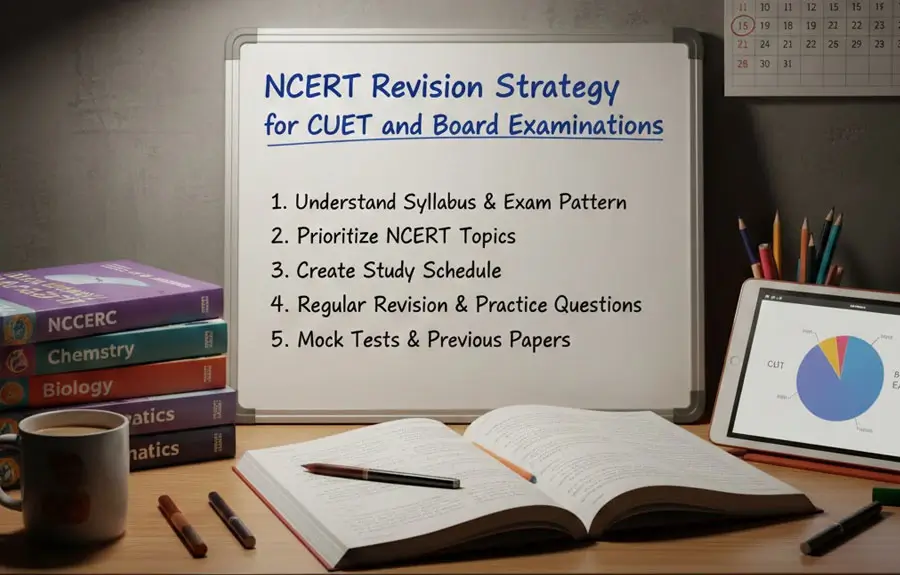
NCERT textbooks form the backbone of school-level education in India. Whether a student is preparing for board examinations or entrance tests like CUET, NCERT content remains the most reliable and syllabus-aligned source. However, many students struggle to revise NCERT effectively, especially when they are preparing simultaneously for boards and CUET. Understanding how to revise NCERT for both CUET and boards helps students streamline preparation and avoid duplication of effort.
Both exams test conceptual clarity, but the way questions are framed differs. Boards focus more on descriptive answers and structured writing, while CUET emphasizes objective understanding, accuracy, and speed. A smart NCERT revision strategy bridges this gap and allows students to prepare efficiently for both formats.
NCERT textbooks are designed by subject experts to match national curriculum standards. Board examinations are directly based on NCERT content, while CUET questions are heavily derived from NCERT concepts and factual information.
Revising NCERT books for CUET and boards ensures that students are not studying irrelevant or out-of-syllabus material. NCERT provides conceptual clarity, standard terminology, and accurate explanations, making it indispensable for both exams.
Ignoring NCERT in favor of guidebooks or coaching notes often leads to gaps in understanding and factual errors.
Although both exams rely on NCERT, the approach to revision must account for their differences. Board exams test writing skills, presentation, and explanation of concepts. CUET focuses on concept-based multiple-choice questions and quick recall.
An effective NCERT revision strategy prepares students to handle both descriptive and objective questions. This requires understanding concepts deeply rather than memorizing lines superficially.
Students must revise NCERT content with adaptability in mind.
Before revision begins, students must ensure they have completed NCERT textbooks at least once. Revision is meaningful only when there is prior familiarity with content.
Reading NCERT line by line helps students understand definitions, explanations, examples, and in-text questions. This initial familiarity forms the base for efficient revision later.
A strong foundation makes NCERT revision for CUET and boards faster and more productive.
Passive reading does not help during revision. Active engagement with the text improves retention and understanding.
Students should underline key terms, mark definitions, and highlight examples while revising NCERT. Writing short notes in the margins helps recall important points quickly.
Active reading ensures that NCERT revision strengthens memory rather than becoming a mechanical task.
Both CUET and board exams value correct terminology. NCERT textbooks use standardized definitions and expressions that examiners expect students to use.
Revising NCERT definitions for CUET and boards ensures accuracy in both objective and descriptive answers. Incorrect terminology can lead to loss of marks even if the concept is understood.
Students should pay special attention to boxed definitions, keywords, and highlighted terms.
NCERT examples and activities are often overlooked, but they play a significant role in concept building. Board exams may ask questions directly based on these activities, while CUET may frame objective questions around them.
Revising NCERT examples and activities strengthens conceptual application and improves problem-solving ability.
Students should practice explaining these examples in their own words to improve understanding.
Visual elements in NCERT textbooks are extremely important. Diagrams in science, maps in geography, and tables in economics often form the basis of exam questions.
Revising NCERT diagrams and maps helps students score easily in board exams and avoid confusion in CUET questions. Students should practice labeling diagrams and recalling map locations regularly.
Visual memory enhances recall speed during exams.
Each subject requires a slightly different revision approach. Science subjects demand conceptual clarity and formula understanding. Social science subjects require narrative understanding and factual accuracy.
Revising NCERT for science subjects involves focusing on concepts, diagrams, and experiments. Revising NCERT for humanities subjects requires understanding timelines, case studies, and cause-effect relationships.
Adapting revision methods to subject nature improves efficiency.
Revision becomes more effective when combined with practice. After revising NCERT chapters, students should attempt practice questions based on those chapters.
For CUET, objective questions help test recall and accuracy. For board exams, descriptive questions improve writing skills.
Integrating NCERT revision with practice ensures readiness for both exam formats.
CUET questions often test fine details from NCERT. Small factual points, examples, and definitions become important.
Revising NCERT with an objective mindset helps students anticipate CUET-style questions. Reading carefully and noting subtle details improves performance.
NCERT revision for CUET should focus on accuracy and precision.
Board exams require structured answers. Revising NCERT content helps students frame answers using appropriate headings, explanations, and examples.
Students should practice writing answers based on NCERT content to improve clarity and presentation.
NCERT revision for board exams strengthens writing confidence and answer coherence.
Short notes act as powerful revision tools. Students should create concise notes after revising each NCERT chapter.
These notes should include definitions, formulas, key points, and diagrams. Revising short notes saves time during the final phase.
NCERT-based short notes help in quick revision before exams.
One-time revision is not enough. Repeated revision strengthens long-term retention.
Students should revise NCERT multiple times, focusing on weak areas each time. Each revision cycle improves clarity and confidence.
Consistency is key to effective NCERT revision for CUET and boards.
One common mistake is skipping NCERT chapters assuming they are easy. Another mistake is relying solely on guidebooks.
Students should avoid selective reading and revise NCERT comprehensively. Ignoring small details often leads to mistakes in exams.
Discipline and focus improve revision quality.
Balancing board and CUET preparation requires effective time management. Students should allocate dedicated slots for NCERT revision daily.
Short, focused revision sessions work better than long, exhausting study hours. A structured timetable ensures balanced preparation.
Time management enhances productivity and reduces stress.
Teachers play a crucial role in guiding NCERT revision. They help students identify important areas and clarify doubts.
Following teacher instructions ensures alignment with board marking schemes and exam expectations.
Combining self-study with teacher guidance improves outcomes.
Revision can feel repetitive, but consistency yields results. Students should stay motivated by tracking progress and celebrating small achievements.
Positive mindset and disciplined routine support effective revision.
Mastering NCERT content builds confidence. Students who are thorough with NCERT feel more prepared and less anxious.
Confidence improves exam performance and decision-making under pressure.
Revising NCERT effectively lays a strong foundation for success in both CUET and board exams.
NCERT forms the base for syllabus and exam questions.
Yes, NCERT is the primary source for CUET concepts.
Multiple revisions improve retention and confidence.
Yes, they help in understanding application-based questions.
Yes, diagrams and maps are scoring areas.
Focus on definitions, examples, and factual details.
Practice descriptive answers using NCERT content.
Yes, it saves time during final revision.
No, guidebooks should only supplement NCERT.
Yes, clarity and familiarity build confidence.

We offer fast delivery.

We offer E-Gift Cards.

Dedicated 24/7 support.

100% secure payment.

 My Order
  0
0