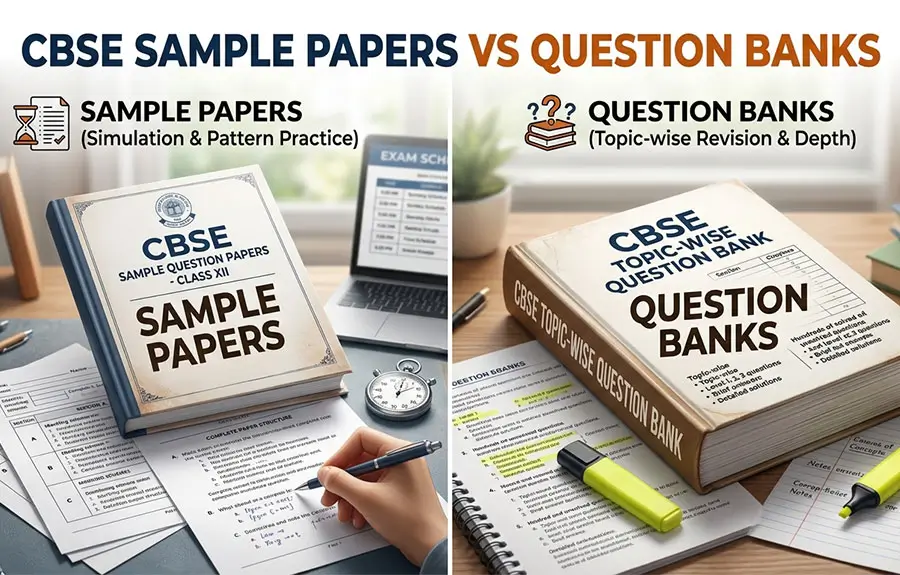
Sample papers are an essential part of CBSE board exam preparation. Almost every Class 10 and Class 12 student uses them to understand exam patterns, practice answer writing, and improve time management. However, students often face confusion when choosing between CBSE official sample papers released by the board and market sample papers published by private publishers. Both claim to be exam-oriented, but they serve different purposes and offer different benefits.
Understanding the difference between these two types of sample papers helps students make smarter preparation choices. Selecting the right type of sample paper at the right stage of preparation can significantly improve exam performance and reduce unnecessary stress.
Sample papers are designed to simulate the actual board examination. They help students become familiar with the structure, difficulty level, and marking scheme of the exam. Practicing sample papers allows students to assess their preparation and identify areas that need improvement.
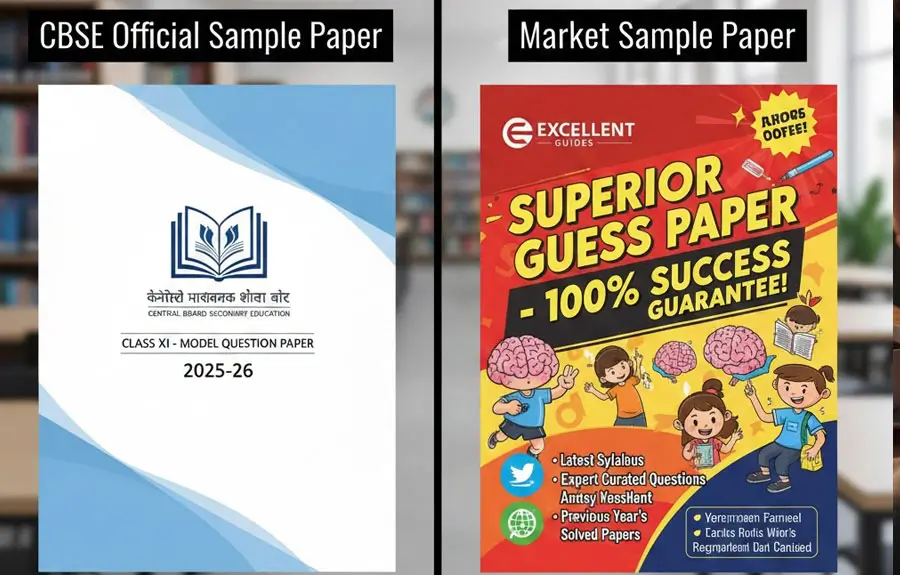
Both CBSE official sample papers and market sample papers aim to support students, but their design philosophy and reliability differ. Knowing these differences is crucial for effective exam preparation.
CBSE official sample papers are released directly by the Central Board of Secondary Education. These papers are created by subject experts involved in curriculum design and assessment.
CBSE official sample papers strictly follow the latest syllabus, exam pattern, and marking scheme prescribed by the board. They represent the most accurate reflection of what students can expect in the actual examination.
These papers are considered authoritative and should be treated as benchmark documents for board exam preparation.
One of the biggest strengths of CBSE official sample papers is their authenticity. Since they are issued by the board itself, there is no ambiguity regarding syllabus coverage or question pattern.
Students can rely on these papers without worrying about outdated content or irrelevant questions. Official papers ensure alignment with board expectations, making them essential for serious exam preparation.
Market sample papers are published by private publishers and coaching institutes. They are widely available in bookstores and online platforms.
These papers are often designed based on previous year trends, teacher experience, and predicted question patterns. Market sample papers may include a wide variety of questions, sometimes beyond the strict board syllabus.
They aim to provide extensive practice and exposure to different question types.
One advantage of market sample papers is the volume of practice they offer. Publishers often provide multiple sets of papers with varying difficulty levels.
This variety helps students practice extensively and build confidence. However, quantity does not always guarantee quality or accuracy.
Students must use market papers selectively and with caution.
CBSE official sample papers are perfectly aligned with the current syllabus and exam pattern. They reflect the board’s assessment philosophy and marking priorities.
Market sample papers, on the other hand, may sometimes include questions that are slightly outside the syllabus or not aligned with the current exam pattern. This misalignment can confuse students if not identified early.
Using official papers helps students stay focused on relevant content.
The way questions are framed in CBSE official sample papers closely matches the language used in actual board exams. This helps students become comfortable with board-style instructions and phrasing.
Market sample papers may use different language styles depending on the publisher. While this can enhance exposure, it may also create confusion for some students.
Familiarity with board language improves exam comprehension and response accuracy.
CBSE official sample papers are accompanied by detailed marking schemes. These schemes explain how marks are awarded for each answer.
Understanding marking schemes helps students learn how to structure answers and include required points. CBSE official marking schemes provide valuable insight into examiner expectations.
Market sample papers may or may not include accurate marking schemes. Some provide generic answers without clear marking criteria.
Official sample papers generally reflect a balanced difficulty level, matching board exam standards. They are designed to test understanding rather than trick students.
Market sample papers may vary widely in difficulty. Some are easier, while others are intentionally made tougher to challenge students.
While difficult questions can enhance practice, excessive difficulty may lower confidence if not used wisely.
During the final phase of preparation, CBSE official sample papers become extremely important. They help students fine-tune their exam strategy and revise content according to board expectations.
Solving official papers closer to the exam builds confidence and ensures alignment with actual exam requirements.
They serve as a reliable reference point during last-minute revision.
Market sample papers are more useful during the initial and middle stages of preparation. They provide extensive practice and help students strengthen weak areas.
These papers expose students to different question types and enhance adaptability. When used correctly, market sample papers complement official papers effectively.
Over-dependence on market sample papers can be risky. Students may spend time practicing irrelevant or outdated questions.
This can lead to confusion and unnecessary stress. It is important to cross-check market paper content with the official syllabus.
Using market papers without reference to CBSE official sample papers may result in misaligned preparation.
The most effective preparation strategy involves a balanced use of both official and market sample papers. Official papers should guide preparation, while market papers should supplement practice.
Students should start with official papers to understand exam expectations, then use market papers for additional practice.
This combination ensures depth, accuracy, and confidence.
Both types of sample papers help improve time management. Official papers help students understand time allocation according to board standards.
Market papers, with varied difficulty levels, help students practice handling pressure and managing time flexibly.
Using both enhances overall CBSE exam time management skills.
Teachers play a crucial role in guiding students on which sample papers to use. They help identify reliable publishers and suggest the right time to use each type.
Teacher feedback also helps students understand mistakes and improve answer quality.
Guided practice ensures effective use of sample papers.
Randomly solving multiple sample papers without a plan can cause confusion. Students should follow a structured practice schedule.
Official papers should be prioritized, while market papers should be selected carefully.
A structured approach improves clarity and reduces overwhelm.
Confidence grows when preparation aligns with exam expectations. Official sample papers build trust in preparation, while market papers build resilience.
Balancing both types helps students feel prepared without feeling pressured.
Understanding the difference between official and market sample papers helps students develop smart study habits.
This awareness prevents misinformation and promotes focused preparation.
The ability to evaluate study material critically benefits students beyond board exams.
They are sample papers released by CBSE following the exact exam pattern.
They are essential but can be supplemented with market papers.
They are practice papers published by private publishers.
They vary in quality and should be used selectively.
Official sample papers should be prioritized.
Yes, they come with detailed marking schemes.
Yes, some market papers are intentionally difficult.
Yes, it may lead to misaligned preparation.
All available official papers should be practiced.
Yes, a balanced combination works best.

We offer fast delivery.

We offer E-Gift Cards.

Dedicated 24/7 support.

100% secure payment.

 My Order
  0
0