The Judiciary Exam, often referred to as PCS J or Civil Judge Examination, is one of the most prestigious legal competitive examinations in India. It offers law graduates the opportunity to enter the judicial services and serve as civil judges within the state judiciary system. Due to limited vacancies and high academic expectations, preparation must be meticulous, concept-driven, and supported by carefully selected resources. Choosing the Best Books for Judiciary Exam Preparation is a foundational step in building a successful strategy.
Unlike many competitive exams that focus on objective problem solving, judiciary exams demand deep conceptual clarity, strong command over bare acts, analytical reasoning, and structured answer writing. Candidates must master substantive law, procedural law, local laws, and language papers. The level of scrutiny is rigorous, and preparation must reflect both academic depth and practical legal understanding.
This detailed guide explains subject wise preparation strategy and highlights the most reliable study resources for Rajasthan and other state judiciary examinations.
The judiciary recruitment process typically includes three stages: Preliminary examination, Main examination, and Interview. The preliminary stage consists of objective type questions from core legal subjects. The mains stage involves descriptive answer writing, testing analytical ability and legal interpretation. The interview evaluates personality, communication skills, and legal awareness.
Core subjects generally include Constitutional Law, Indian Penal Code, Criminal Procedure Code, Civil Procedure Code, Evidence Act, Contract Act, Specific Relief Act, Transfer of Property Act, and Local State Laws. Language papers test drafting skills and translation ability.
A strong Judiciary Exam Preparation Strategy requires early clarity about syllabus weightage and state-specific laws. The Best Books for Judiciary Exam Preparation must offer detailed conceptual explanations, case law references, and previous year question analysis.
Constitutional Law forms the backbone of judiciary examinations. Questions often test interpretation of fundamental rights, directive principles, constitutional amendments, and landmark judgments.
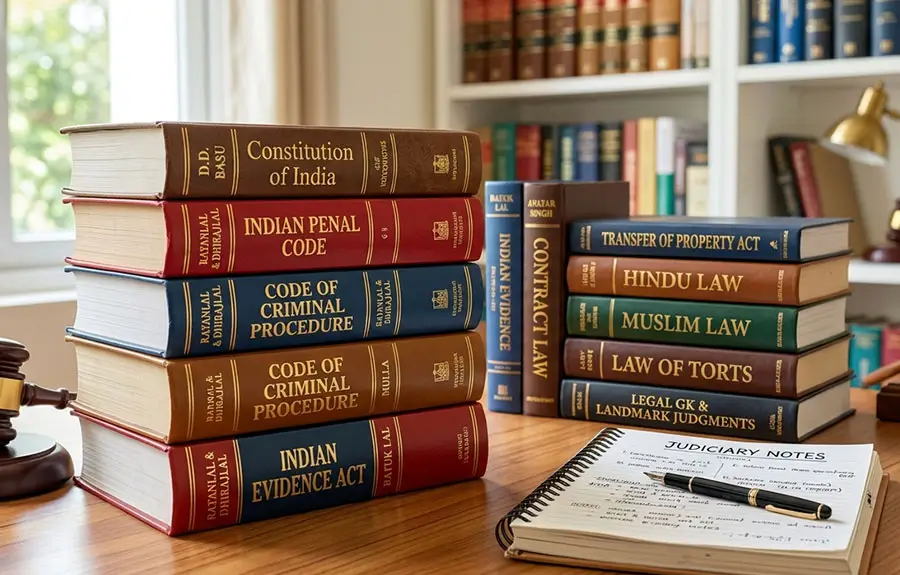
Introduction to the Constitution of India by D.D. Basu is widely regarded as a foundational reference book. It explains constitutional provisions in a clear and structured manner. For deeper analytical understanding, advanced commentaries on constitutional law are useful.
A disciplined Judiciary Exam Preparation Strategy involves reading constitutional articles directly from the Bare Act along with understanding judicial interpretations. The Best Books for Judiciary Exam Preparation in constitutional law must combine theoretical explanation with case law analysis.
Repeated revision of landmark judgments strengthens conceptual clarity and improves answer writing quality.
Civil Procedure Code and Criminal Procedure Code are procedural subjects that demand precision and conceptual clarity. Questions often focus on jurisdiction, appeals, limitation, execution proceedings, and procedural compliance.
For CPC, standard commentaries such as C.K. Takwani on Civil Procedure provide detailed explanation and practical examples. For CrPC, authoritative books explaining procedural flow help in understanding stages of criminal trial.
The Best Books for Judiciary Exam Preparation in procedural law must offer structured explanations and highlight frequently tested provisions. Reading Bare Acts thoroughly remains non-negotiable. Candidates should underline important sections and create short notes for quick revision.
Indian Penal Code covers substantive criminal law including offences against body, property, state, and public tranquility. Evidence Act requires understanding of admissibility, burden of proof, and relevancy of facts.
Ratanlal & Dhirajlal on IPC is considered a reliable reference for detailed explanation. For Evidence Act, conceptual clarity can be strengthened using structured commentaries aligned with judiciary exam syllabus.
A strong Judiciary Exam Preparation Strategy in criminal law involves linking sections with practical examples and case laws. The Best Books for Judiciary Exam Preparation must provide clarity on essential ingredients of offences and evidentiary principles.
Bare Acts form the foundation of judiciary preparation. Many questions directly test section language and interpretation. Candidates must read Bare Acts repeatedly to understand statutory wording.
Case laws are equally important, especially for mains examination. Referencing landmark judgments in descriptive answers enhances scoring potential.
The Best Books for Judiciary Exam Preparation support understanding, but Bare Act reading remains indispensable. Revision of statutory provisions ensures confidence during objective as well as descriptive stages.
Judiciary mains include language papers requiring essay writing, précis writing, and translation skills. Regular practice improves drafting clarity and legal articulation.
A disciplined Judiciary Exam Preparation Strategy involves writing practice under timed conditions. Reviewing previous year mains questions helps in understanding answer structuring.
The Best Books for Judiciary Exam Preparation in language sections must include model essays and translation exercises aligned with exam requirements.
Mock tests help simulate real exam pressure and improve time management. Solving previous year question papers reveals pattern trends and frequently tested topics.
Candidates should analyze mistakes carefully and revise corresponding sections. A consistent evaluation process strengthens weak areas and enhances confidence.
The Best Books for Judiciary Exam Preparation often include topic wise solved papers that assist in structured revision.
Judiciary preparation demands long term discipline. Aspirants should divide study time between substantive law, procedural law, local laws, and language practice.
Rotating subjects weekly prevents monotony and strengthens retention. Short notes and section summaries help during final revision.
Success in judiciary examination requires clarity, consistency, and strategic resource selection.
Introduction to the Constitution of India by D.D. Basu is highly recommended.
Bare Acts are essential but should be supplemented with explanatory commentaries.
They help identify question trends and important topics.
Yes, structured answer writing significantly improves scoring.
C.K. Takwani on Civil Procedure provides clear explanations.
Understand essential ingredients of offences and revise important case laws.
With consistent Bare Act reading and conceptual clarity, it becomes manageable.
Consistent disciplined study with subject rotation is effective.
With focused preparation and right books, success is achievable.
Concept clarity, Bare Act mastery, and structured revision are essential.

We offer fast delivery.

We offer E-Gift Cards.

Dedicated 24/7 support.

100% secure payment.

 My Order
  0
0